



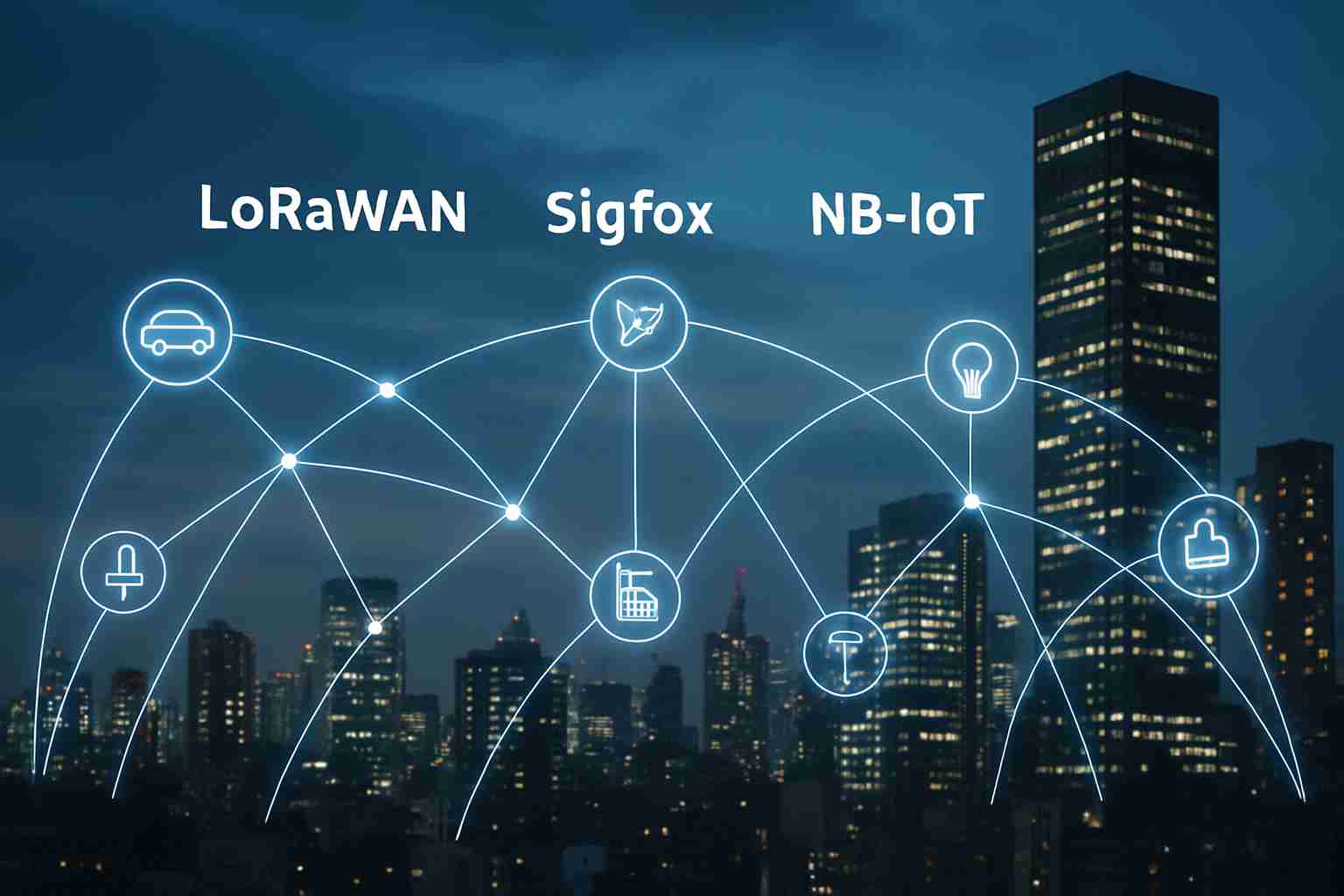
At the forefront of long-range IoT communication in today’s rapidly advancing Internet of Things (IoT) landscape are Low-Power Wide-Area Network (LPWAN) systems. This discussion delves into the leading LPWAN communication technologies—LoRaWAN, Sigfox, and NB-IoT—outlining their distinctive attributes, usage scenarios, and the significant role they play in shaping IoT connectivity via LPWAN technology.
Understanding LPWAN Technologies
Within the intriguing realm of IoT connectivity, low-power wide-area network technologies stand out as truly revolutionary. Designed to facilitate long-distance communication while consuming minimal energy, these networks are perfect for scenarios requiring the transfer of only small data packets across expansive areas. Leading the forefront among such technologies are LoRaWAN, Sigfox, and NB-IoT, each bringing unique strengths to the table. LoRaWAN employs a chirp waveform spread spectrum method, enhancing its capacity to sustain connections over extended distances while preserving battery life in standalone battery-operated IoT hardware. In contrast, Sigfox utilizes ultra-narrowband communication systems that maximize spectrum efficiency and significantly expand coverage reach. NB-IoT leverages existing mobile IoT communication networks to deliver broad and reliable coverage, albeit at lower data rates. What makes these technologies truly impressive is their ability to enable a vast array of IoT solutions, from dense urban infrastructure to remote rural use cases. By emphasizing efficiency and expansive coverage, the low-power wide-area network sector continues advancing, fostering scalable and sustainable IoT ecosystems across the globe.
The Role of LoRaWAN in IoT Connectivity
LoRaWAN stands out in the LPWAN arena, recognized for its groundbreaking method of IoT connectivity via LPWAN technology that offers flexible data rates and capacity. It utilizes an open standard and taps into license-free spectrum, enabling smooth integration across diverse applications like smart urban IoT communications and remote area connectivity. Its versatility suits monitoring in isolated locations and portable IoT devices with battery power, providing extended network coverage with minimal upkeep.
Designed to accommodate numerous devices at once, the LoRaWAN framework maintains data transmission integrity efficiently. Multiple intuitive layers in its architecture manage seamless communication from endpoints through gateways to network servers. This infrastructure supports tiny data packets traveling long distances, a crucial aspect for long-range IoT communication.
Security in LoRaWAN is fortified by layered encryption protection, shielding data from the device all the way to the server. Its energy-optimized IoT networking and broad coverage guarantee dependable connectivity even within dense metropolitan areas. Continuing to expand the horizons of low power wide area network technology, LoRaWAN drives the evolution of IoT ecosystems forward.
Exploring Sigfox for Global IoT Communication
In the field of low-power wide-area network technologies, Sigfox stands out due to its use of ultra-narrow spectrum technology. By utilizing this highly selective band technology, Sigfox radio networks allow devices to send small packets of data over extensive distances while consuming very little energy and requiring minimal infrastructure. This technique significantly extends the range and battery life of IoT gadgets and substantially reduces connection expenses, making it an attractive option for scalable worldwide implementations.
Sigfox’s infrastructure, known for its robustness and simplicity, is particularly effective when remote monitoring and location tracking are essential. For example, in asset management systems, sensors send infrequent, compact data bursts, which help conserve both power and bandwidth. Additionally, Sigfox adopts a composite low-power wide-area network solution enabling seamless integration with other communication technologies, thereby boosting its adaptability.
This strategic blending facilitates dynamic applications relying on both broad deployments and cost-efficient, effective communication. Whether it’s environmental monitoring in remote regions or global shipment tracking, Sigfox’s combination of extended range, low energy usage, and affordability solidifies its position as a premier choice within the low-power wide-area network landscape.
NB-IoT and Its Impact on IoT Devices
Narrowband IoT (NB-IoT) represents a crucial standards-based LPWAN technology created by the 3rd Generation Partnership Project (3GPP). Utilizing existing cellular infrastructure, it encourages broad adoption in multiple industries thanks to its efficient use of spectrum and reliable coverage. NB-IoT’s seamless integration with other LPWAN communication technologies makes it a strong contender for urban and industrial IoT applications. Without straining network systems, its distinctive ability to boost connectivity contributes greatly to the advancement of future 5G networks. Enhancing IoT wide-area communication through longer battery life and improved signal penetration in tough conditions, NB-IoT effectively narrows connectivity gaps in high-density regions. Devices equipped with NB-IoT enjoy lower power consumption alongside heightened dependability, positioning it perfectly for smart urban projects, environmental surveillance, and asset management systems. As the 5G era progresses, NB-IoT remains vital by blending smoothly with rising network requirements and raising Internet of Things connectivity standards. This integration reduces latency, conserves energy, and ultimately optimizes the overall performance of IoT ecosystems.
Comparing LPWAN Solutions for Future IoT Expansion
When choosing the best low power wide area network solutions for expanding IoT, it’s important to evaluate network scalability, operational complexity, and commercial feasibility across LoRaWAN, Sigfox, and NB-IoT. LoRaWAN stands out for its simplicity and adaptability, making it ideal for extensive deployments with diverse power and bandwidth demands. Sigfox leverages its ultra-narrowband technology to thrive in cost-efficient scenarios requiring minimal network traffic and long battery life. Conversely, NB-IoT boasts wide coverage via existing cellular infrastructure, perfectly suited for urban environments where dense and dependable connectivity is critical.
LoRaWAN’s open network architecture ensures secure data transfer over vast distances, supporting varied applications from smart agriculture to logistics. Sigfox is increasingly favored for asset tracking solutions and remote monitoring thanks to its low-cost approach. NB-IoT plays a vital role in industrial IoT networks and smart city IoT connectivity, facilitating a smooth path to 5G IoT integration.
Distinct advantages characterize each technology, and the industry trend is moving toward hybrid LPWAN networks. By merging features from multiple low power wide area network platforms, robust and scalable IoT network solutions emerge, encouraging sustainable and expandable IoT connectivity through complementary capabilities.